
Startup ecosystems are built through continuity. Founders need different kinds of support at different stages of their journey, and no single organization can provide all of it.
That's why partnerships matter. Over the years, both Future Unicorns and Sofia Tech Park have supported founders from the earliest stages of company building through international acceleration. Alumni including Barin Sports and VIHRA AI are just two examples of founders who have benefited from that continuity, moving through different programs as their companies evolved.
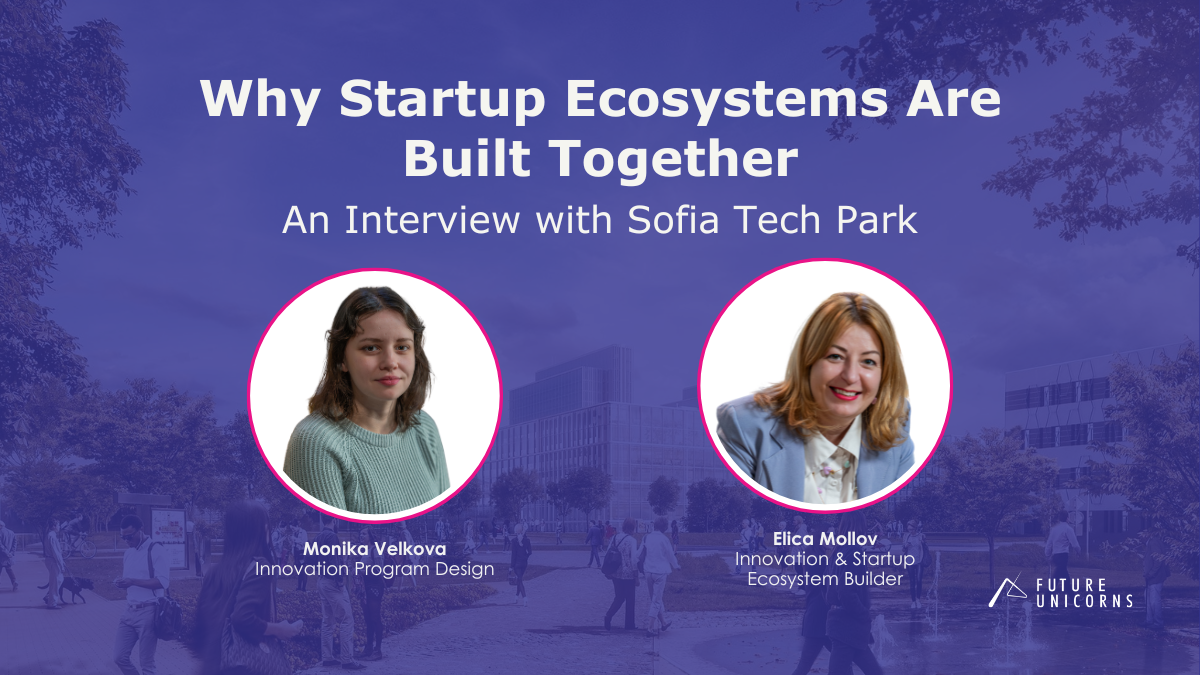
To explore what it takes to build stronger founder ecosystems across Central and Eastern Europe, we spoke with Elica Mollov and Monika Velkova from Sofia Tech Park about ecosystem collaboration, founder infrastructure, and why long-term partnerships matter just as much as individual programs.
Elica Mollov: Collaboration between accelerators, innovation hubs and major actors in the ecosystem is essential, as the region is fragmented. There are unique challenges each country faces, with different economic priorities, internal policies and regulations. There are 4 regions - Baltics, Central Europe, Eastern Europe and Balkans - some countries part of the EU, some not. In terms of actors in these ecosystems - often, an implemented united policy within each country is missing, leading to a loss of alignment between private and public support mechanisms.
The collaboration is often a product of the ambitions and good will of each organization, as the need to connect and create mutual initiatives is clear, since no company or even consortium has unlimited reach and resources. In our experience of connecting with organisations locally and on the Balkans, there is always a mutual understanding, collaborativeness, welcoming energy and hunger for new ideas, competitions, initiatives - just like a startup.
Monika Velkova: From my experience, collaboration falls short because of the fragmentation - there are many decision-makers who need to align for anything to happen. This would be alignment of efforts, of time, of capital, of mission and vision for their local ecosystems. After the initial contact and exchange of know-how, synergy is straightforward, but the uniting activity is sometimes difficult to conceptualise and establish, especially since there is a need for regular repetitive events, interactions and updates. All this is supported buy the partnering organizations and relies on their dedicated efforts on top of their already established local responsibilities and mission.
Elica Mollov: We believe it is essential to provide resources early on, because it dramatically reduces the validation of the product or service. Innovative ideas can be difficult to validate, exactly because they rely on new implementation or development of technology. Disruptive companies, which have the potential to become unicorns are even more resource-hungry, requiring compliance with different regulations depending on the market and the complexity compounds as they grow. This is part of the process which shouldn’t be overlooked by ambitious founders and we aim to support the process by providing early access to scientific expertise, infrastructure, mentoring and community.
Monika Velkova: From our experience, founders are always operating under enormous uncertainty, even more so when they transition from one stage to another - from validation, to market entry, to growth, to international scaling. Those shifts require rapid adaptation and new skill development because they uncover any weak spots. Each startup founding team has their own difficulties, depending on internal capacity, industry of choice and initial market geography. Relying on venture funding to jump through those hoops is not a winning strategy.
Elica Mollov: There is always a need for early support, especially for first-time founders developing innovative technological products and relying heavily on RnD. Different incubation programs, challenges and activation events in support of founding teams are essential. There are so many unutilised inventions and IP, created by talented individuals who don’t see the road to commercialization. According to the Global Innovation Index, 2025, Bulgaria ranks 28th in the domain of Knowledge and technology outputs, but 50th in Business sophistication. There is indeed more scope to connect into a national entrepreneurial ecosystem, but that depends on governmental support and policies. At Sofia Tech Park, we support teams in the early stages, as well as newly registered entities with essential services and know-how, targeting improved RnD capacity, market entry and investment readiness.
Monika Velkova: CEE is still very fragmented, countries specialize and develop different economic strategies - manufacturing and services, ICT development, raw goods export, industrial specialization. The market specifics drive founders to also heavily specialize and build custom solutions, but going too niche can be at the expense of future growth rate. It is important for more organisations supporting entrepreneurs to connect, because it allows for exchange of experience, best practices and new initiatives - cornerstones, which allow startup exchange and subsequent exposure of founders to different market contexts. What would be ideal to make such insights more easily accessible is a regional digital platform, mapping available resources, active funds, BAs and regulations, which some countries have already developed for their markets to different extents
Elica Mollov: Startup ecosystems rely on multiple stakeholders and organizations and their interconnectedness, timely communication and shared links. Those relationships are built with time and based on recognition of mutual goals and subsequent strong collaboration. Because of the specialization of resources each organisation provides, for founders what matters is to quickly navigate and map their way. For the ecosystem to work as intended, the coordination of those efforts - the consistency, ideation and time commitment - are monumental and fall on the teams. Long-term support is effective when it adapts to the founder’s needs and venture’s growth rate, not the other way around. This usually results in founding teams going through several different incubation or acceleration programs and challenges, to initially upskill and receive mentoring, later to use RnD resources and discounts, meeting rooms and office spaces. It’s important to also highlight large tech companies which support startups through dedicated software service discounts, cloud credits or virtual product test labs.
Monika Velkova: There are already a lot of scaleups, rising stars and unicorns in the region. However, as startups scale, founders are confronted with the need to pursue higher investment tickets, requiring presence or relocation of part of the business into large tech hubs outside the region, some going to the US or Asia. This sadly is the reality - there is a reliance on capital concentration outside of the region. Changing this would require a more organized cohesive approach towards capital investments, PE firms and VC funds - supported by reforms in policies advocated by agencies such as ‘Invest Europe’. Such steps would strengthen the ecosystem and make it more independent, allowing CEE founders to keep development, oversight and profits locally, supporting the ecosystem back.

