

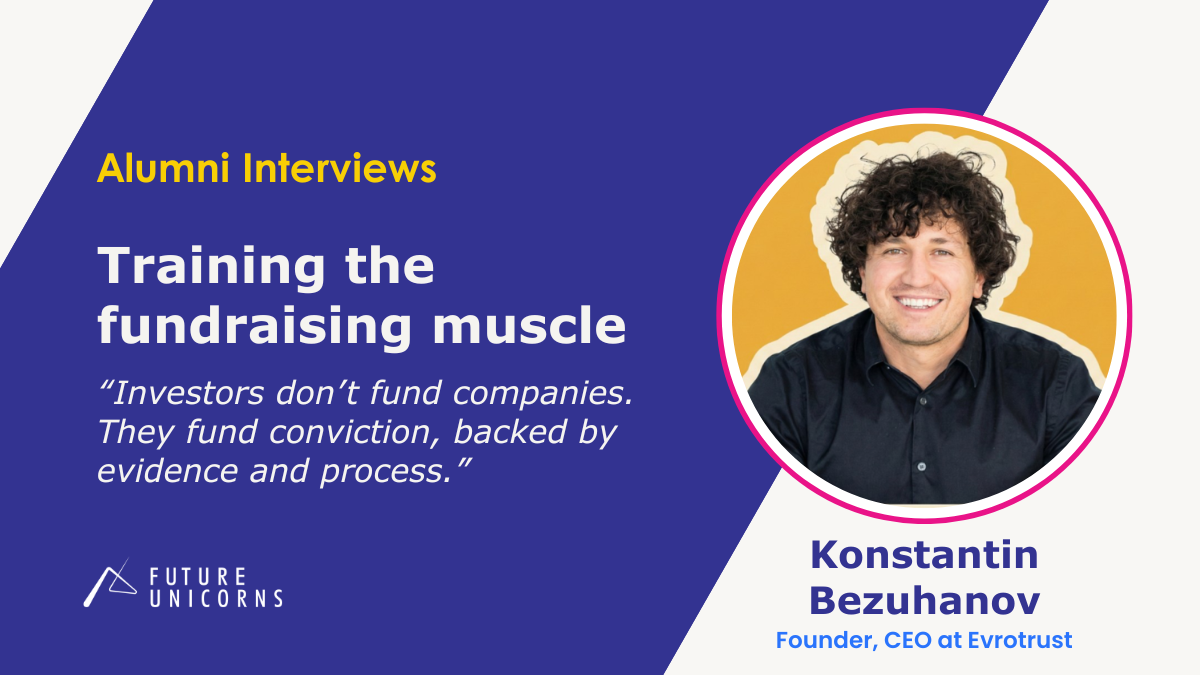
In this conversation, Konstantin Bezuhanov, CEO and co-founder of Evrotrust, reflects on the inflection points that shaped the company’s journey, from early founder learning moments inside the Future Unicorns program to the level of operational maturity required to sell digital trust infrastructure at scale. He shares how Evrotrust evolved from a promising solution into a platform that banks, regulators, and enterprises can depend on, unlocking deeper integrations, multi-country rollouts, and long procurement cycles.
We also talk about fundraising as a structured process rather than a one-off event, a mindset that proved critical as Evrotrust closed its 2025 funding round and accelerated its international expansion, including entry into the Romanian market. Throughout the interview, Konstantin is candid about what founders often underestimate, what compounds over time, and why speed only becomes an advantage once trust is firmly in place.
A Future Unicorn's alumnus, Konstantin offers a grounded, experience-backed view into what it really takes to build durable companies in regulated, high-stakes markets.
It was a pivotal moment for how I think as a founder. What stood out immediately was the level of knowledge-sharing from people with real experience. It was incredibly valuable to hear what others were building and struggling with, especially because many of us had gone through very similar early-stage challenges.
I made a conscious effort to make the most of the connections. I had follow-up meetings with around 80% of the mentors, which says a lot about how much they go above and beyond. These were real connections we were making. Through the program, I also ended up finding one of my advisors, Simeon Simeonov. Even before he formally came on board, he spent several months talking with me every Saturday for two to three hours at a time. He was extremely generous with his time, and that wasn’t something official or expected from him.
Yes, credibility at institutional speed. In the early days, we could build fast, iterate fast, and convince early adopters. But certain doors simply don’t open until you’ve proven you can operate like infrastructure: reliably, securely, and predictably, at scale.
As we matured, we moved from “a promising solution” to “a platform institutions can depend on.” That shift unlocked things like bank-grade procurement cycles, deep integrations, and multi-country rollouts that require a very different level of operational maturity. We could show a repeatable pattern, not just that our technology works, but that it keeps working under audits, under peak usage, and under the scrutiny of risk teams.
It also changed the type of conversations we could have. Instead of pitching a feature, we could talk about reducing onboarding friction, improving conversion, and increasing compliance certainty, and back it with evidence. That’s when strategic partnerships became possible too, when you’re no longer “one vendor,” but part of how a regulated organization runs its digital processes.
In short, maturity didn’t just bring bigger clients. It brought a different category of trust, and trust compounds.
The biggest muscle was learning to treat fundraising as a structured sales process, with the same discipline you’d apply to enterprise GTM (go-to-market, meaning how you sell, distribute, and grow). You’re not selling the product. You’re selling equity, which is essentially the “product” investors buy.
Future Unicorns helped us internalize that fundraising isn’t a single event. It’s a pipeline. You need positioning, targeting, sequencing, follow-ups, and a clear narrative that holds up under pressure. The program pushed us to build a repeatable system: define the right investor profile, sharpen the story, anticipate objections, and run a cadence that creates momentum.
It also taught me to separate “interest” from “commitment” and to manage the process with the same clarity as a sales funnel: what stage each investor is in, what proof they need next, and what the next action is. Importantly, it also helped me get comfortable leading the conversation with confidence, because uncertainty is contagious in fundraising.
That shift alone changes outcomes, because investors don’t fund companies. They fund conviction, backed by evidence and process.
From the beginning, we made a very intentional choice: we would build on standards that regulators and institutions already trust, and then make them radically easier to use.
In our space, trust isn’t a marketing claim. It’s an outcome of compliance, security, and consistency. We anchored ourselves in eIDAS, the EU regulation for electronic identification and trust services, and focused on the highest assurance level: Qualified Electronic Signatures (QES), which is the strongest legal form of e-signature in the EU, designed for maximum non-repudiation (meaning it’s very hard to credibly dispute who signed and what was signed).
But the key wasn’t only “being compliant.” The real decision was this: don’t force users to pay the price of compliance in friction. We relied on legally accepted identity verification methods, cryptographic proof, audit trails, and strong operational controls, then invested heavily in experience and integration so adoption wouldn’t stall in legal, risk, or IT.
Trust accumulated through hundreds of small, consistent proofs: clear documentation, predictable performance, transparent security posture, and never overpromising. Over time, that creates a compounding effect. Each successful onboarding, each completed audit, each institution that relies on you, makes the next “yes” easier.
I think founders sometimes underestimate the value of talking to real founders. Today, there’s so much information available through AI and other tools that people can become reluctant to invest time in live learning.
But even if you’re good at using AI, this is not comparable to a GTM prompt, it was a specific journey carefully designed for each startup, with a well-thought-through curriculum, which created the space for Q&As, and with people who can go deeper into your specific situation and connect you to others through their networks. That combination is often overlooked.
This is also something you do once, as it’s a paid program. But in my case, the value I got helped me optimize the valuation of my first round by a factor of at least 5–10%. So when I look at it that way, the price tag made complete sense.
You have to bring participation and focus. In my case, the timing actually helped a lot. Because the sessions followed US hours, they usually started around 6 or 7 in the evening and lasted one to two hours, which made it easy to stay engaged without interfering with my day-to-day work.
From my perspective, there’s nothing missing for founders in our region. We have access to build whatever we want. If founders want something badly enough, they can go get it without anything stopping them; most people are just one LinkedIn message away.
This said, creativity is probably the area we should tune into more. Access to Western markets already exists, but an advantage of this program is that it helps you plug into those ecosystems faster and in a more targeted way.
First, looking back is always easier than looking forward. “You can’t judge yesterday’s decisions by today’s information” is a mantra I strongly believe in. But if I had one guaranteed assumption, 100% product-market fit, I would be more aggressive, earlier.
I would push sooner on three fronts:
The first is distribution and partnerships earlier. In digital identity, trust is necessary but not sufficient. Distribution wins. I’d invest earlier in ecosystem routes: integrators, platforms, and channels where adoption can scale faster than founder-led sales alone.
The second is international positioning sooner. I’d move earlier to shape the narrative outside our home market, because credibility is global in this category. The moment you’re building regulated trust infrastructure, your market is defined by regulation, not geography.
Last but not least, productizing integration sooner. I’d invest earlier in developer experience, including APIs, documentation, and onboarding flows, so enterprises can adopt faster with less custom effort. Procurement cycles are long enough. Integration shouldn’t add months.
And I’d be more ruthless about focus: pick the clearest wedge, win it decisively, then expand. With PMF assured, speed becomes a strategic weapon. Not reckless speed, but confident speed.

