

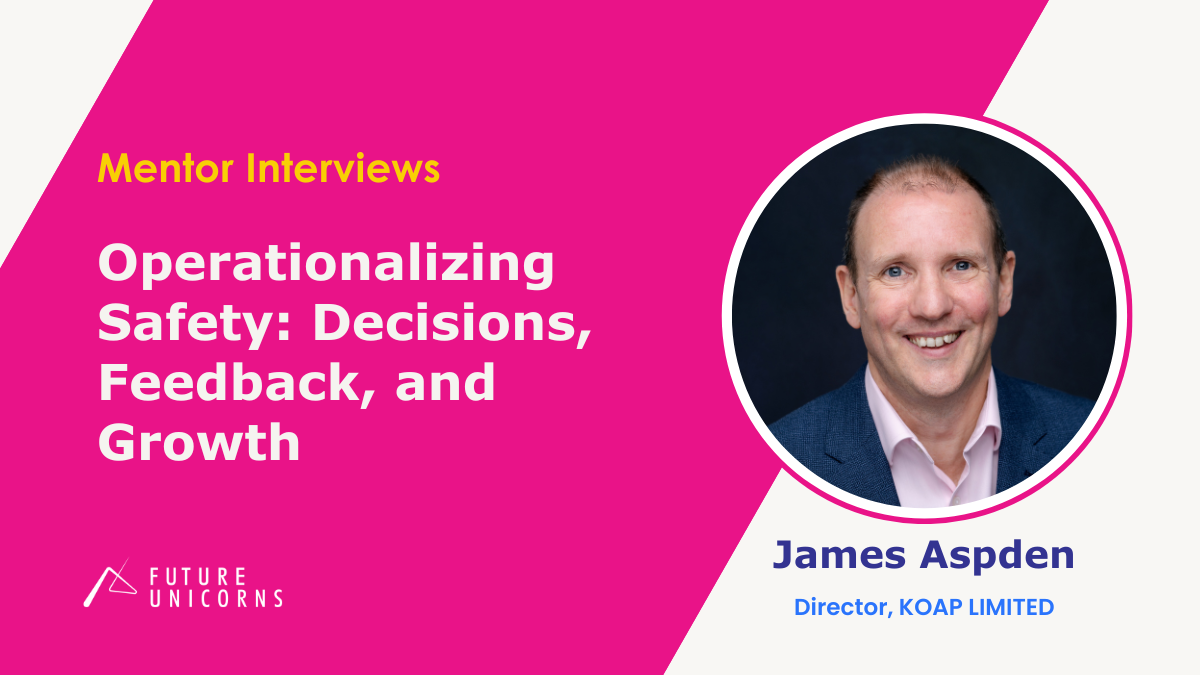
James Aspden works with teams at the point where performance is shaped in practice, inside everyday decisions, feedback loops, and how accountability is distributed across the team.
Through KOAP, his focus is on turning concepts like psychological safety into something teams can operate with, influencing how people contribute, challenge ideas, and respond under pressure.
His work spans organizations at different stages, but a consistent pattern runs through it: as companies grow, the quality of execution becomes tightly linked to how teams communicate and make decisions, especially when stakes increase.
As a mentor in the Future Unicorns program, he brings that lens into our cohort companies, working with founders on how their teams function as they scale, and how those internal dynamics shape outcomes as much as the product itself.
In working with multiple organisations around the world, I’ve found that part of the problem is understanding the definition of what psychological safety is. It’s not a free-for-all where anyone can say whatever they want, equally, it’s not a place where people have to agree and have harmony. Psychological safety is the environment where people feel safe to be themselves, they feel safe to offer their ideas and thoughts (even if they’re not fully formed), they feel safe to ask for help and to challenge the status quo. In operational terms, you see psychologically safe teams discussing new ideas, building on each other’s thoughts and supporting diverse ideas.
Individual feedback is seen as a gift, a recognition of a job well done or an ability to improve. Where individuals don’t feel safe, constructive feedback is viewed as criticism and dismissed. In teams, when things go wrong in a psychologically safe environment, the team understands feedback and post mortems as a way to get better, when it’s unsafe, the feedback becomes more about defensive thinking, blaming others and trying to protect themselves.
When you have a psychologically safe team, everyone is empowered to bring any challenges to the attention of everyone. So, from an operational perspective, even when things are running smoothly, near misses or mistakes are raised, continuous improvement is embraced and knowledge is shared more readily across the team.
There are 2 extremes to this, the first is where there’s a lot of conflict and blaming others. The other, sometimes more difficult to notice, is when there are no arguments or discussions in meetings. Harmony is not safe, if nobody has a different viewpoint then the team doesn’t feel safe to speak up, challenge or give a different viewpoint.
This can happen in different ways. We have a group of founders who, by definition, have had a great idea and are perusing it. As the team grows, you surround yourself with highly talented individuals who are as smart (or smarter) than you. You set out to create psychological safety but sometimes can feel threatened by the ideas of others especially if it goes against one of your own ideas. At this point, as the leader of the organisation, how do you recognise that you’re getting defensive and rather than shutting the idea down, be able to pause, listen and be curious about the different opinion?
In larger organisations, and in small businesses too, the impact of daily pressures can’t be overlooked. It’s easier to be curious and listen when you have lots of time, shorten the timescales, introduce complexities from customers or have unexpected delays, pressure increases and it’s easy to go back into “founder mode” and do the work yourself. This undermines your team and negatively impacts psychological safety.
In the right quantities, pressure (or the release of adrenaline and cortisol) have positive impacts on the mind and body, the cocktail boosts energy, memory and focus. However, too much pressure starts to shut down our cognitive brain functions and we start to react emotionally.
How does this show up in teams? Some people become “hotheaded”, others retreat and say nothing and many will become paralysed and unable to make a decision. The challenge for our founders is that pressure is different for everyone, the same situation will strongly motivate one person and cause the other to go into panic. The only way to know how pressure will impact them is to have a psychologically safe environment where people can be open & honest about how they feel without judgement.
There have been many but a common example is being able to change a disgruntled employee into a high functioning team member.
In one example, there was an established team of 12 people, one of whom had been at the organisation many years and had the brand of a malcontent. Comments about this individual were “Yes, well, that’s just the way he is”, “Just ignore him” or “He’s been here for years and you’ll never change his mind”.
I had a 1-2-1 with the manager of the team and we discussed this individual as they were creating not only a psychologically unsafe environment but overall performance by the team was also low. I started by asking if the manager knew why the person behaved that way? As our discussion continued, it was clear that, for many years, this person had been ignored which had compounded the problem. The manager left our meeting with 1 task – to have an open conversation and listen to his team member.
The next month we had another 1-2-1 – the impact was enormous. The manager found out that the reason for the behaviour of the team member was frustration – he had lots of ideas but they were all dismissed as “complaining”. When the manager started to listen and understand, he went back through all the ideas the team member had submitted over the past 5 years, some were no longer applicable but others were still viable and these were implemented.
The impact on the individual team member, and the broader team, was a complete turnaround from a psychologically unsafe team where people didn’t want to have any new ideas to a team who came together and proactively looked for ways to improve.
The “move fast” mindset is incredibly effective in the early stages, but it starts to break down as complexity increases. As the company expands, context and communication become more important. When changes happen, the “why” is vital. If people don’t know why a change is happening then this creates threat and threat will slow down execution. As a leader you still want things to progress quickly but you find yourself having more conversations with your frightened team members rather than conversations on how to move forwards.
So, move fast can be great to build momentum but often we need to slow down to speed up.
I see the biggest challenges in letting go. Our founders are going to be passionate about their product or service they have created – it’s “their baby”. Then, growth happens and you have to share it with everyone, this can be a big challenge and feel like you’re losing control. I’ve experienced this before where the founder can counteract this by putting in reporting lines where all decisions must be made by the founder – this not only creates a bottleneck for all decisions but also takes away autonomy from the very smart people who were hired to do the job. Ultimately, the founder burns out from overwork and the team members move onto another role where they feel they can make an impact.
If I had to pick one I would say it was creating a psychologically safe environment for the organisation. The theory is simple but it’s role modelling the behaviours every day which can be a challenge. Giving autonomy to make decisions without blame if things go wrong, welcoming feedback and acting upon it and creating a space where there is positive conflict. Positive conflict is a constructive, purposeful engagement with disagreement that sparks growth, fosters innovation and strengthens relationships rather than destroying them.

