
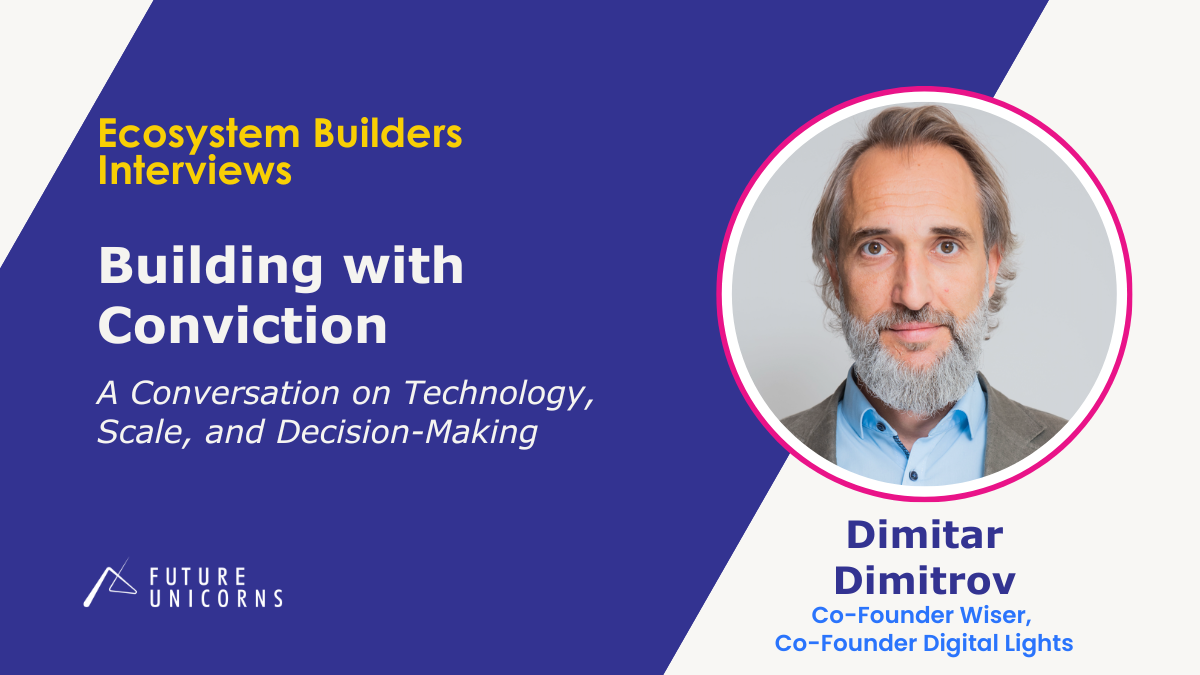
Dimitar Dimitrov is part of a generation of founders who grew alongside the region’s tech ecosystem, starting from first principles and building their way into scale. With a background in mathematics and computer science, he moved early from theory into execution, working as a software engineer while still a student and later transitioning into company building.
Today, he operates at the intersection of technology, business, and education. As a leader within Wiser Technology, a publicly listed company with over 500 hundred engineers, he has been involved in scaling teams, structuring organizations, and shaping long-term strategy. At the same time, he has spent over a decade lecturing at Sofia University, focusing on applied innovation and working closely with the next generation of technical talent.
His perspective is shaped by both sides of the system, building companies while contributing to how future founders and engineers are formed.
I always had a natural inclination toward mathematics. It came easily to me, much more than other subjects, and I enjoyed the clarity and structure it offered. Then, in high school, I had an informatics teacher who introduced us to programming. That was the first time I encountered it in a meaningful way, and I was immediately drawn to it. What’s interesting is that at that time I didn’t even have a computer at home. But that didn’t matter. The conceptual side of it, algorithms, logic, the idea that you can build systems from first principles, was enough to capture my attention.
From there, the path was quite straightforward. I went on to study Informatics at the Faculty of Mathematics and Informatics at Sofia University, which gave me a strong foundation not just in programming, but in thinking structurally how to represent the reality we live in into software code. Already in my second year, I started working as a software engineer, and from that point on, I’ve been consistently building in this space.
You cannot sustain this kind of work if you don’t genuinely enjoy it. There are periods, sometimes years, where the workload is extremely intense, where you might be working 16 or 18 hours a day. If you perceive that as a burden, it simply won’t work long term.
For me, I love my profession and job. I enjoy recreating our world via software and solving complex business challenges, and working in a team with people. That’s what makes it truly enjoyable and sustainable.
At the same time, I’ve always been curious beyond just execution. Early on, I realized that while the university provided a strong theoretical base, there were gaps when it came to applying that knowledge to real-world innovation. That’s what led me to start teaching, initially as a student, and then later in a more formal way.
It’s a very important part of how I think about contribution. This is my 11th year lecturing at Sofia University, and I work with a very selective group of students. We focus on applied innovation, designing and building real solutions, not just discussing theory.
For me, it’s one of the most meaningful ways to give back. I share everything I’ve learned, both from engineering and from entrepreneurship perspectives.
There’s also something very energizing about working with students. You see how they think, how they approach problems, how their expectations are evolving. It keeps you grounded and connected to earlier stages of the journey.
At the same time, it reminds me of the moments that influenced my own path. I had a professor who was running a software company, and just hearing him talk about building solutions for real businesses was incredibly inspiring. That stayed with me. It made the idea of building something of my own feel tangible.
It was not a sudden shift. It was gradual.Initially, I was very focused on the technical side. That’s what I knew best and that’s what I enjoyed the most. But as you start building companies, you realize that technical excellence alone is not enough.
You need to understand how to create value for customers in a sustainable manner, how to communicate with the market, how to structure teams, and how to build the right economics around the company.
At some point, I realized I was over-indexing on engineering and not paying enough attention to the administrative side. That’s why I decided to pursue an Executive MBA, to build a more complete perspective. What changed for me over time is that I stopped separating work into “technical” and “non-technical”.
Administrative work is equally important. If something needs to be done for the company to succeed, then it has the same weight as any technical decision.
What changes is not just the size, but the type of challenges you’re solving. In the early days, it’s about survival. You’re a small team, you’re trying to build something that works, you’re learning very quickly, often under high pressure.
As you grow, the complexity shifts. It becomes less about individual contribution and more about systems, how teams work together, how decisions are made, how you maintain highest quality at scale.
But one thing that hasn’t changed for me is the sense that we are still at the beginning. Even now, with Wiser, a mid-sized company, I still see it as an early stage in a much larger journey. The potential ahead is significantly greater than what we’ve already achieved. That perspective matters, because it keeps you humble and focused on building, rather than becoming complacent.
One of the core ideas is reflected directly in the name, Wiser.The concept is about becoming a better version of yourself every day. About continuously learning, improving, and collecting wisdom.
This is not just philosophical. It has practical implications. It affects how we approach clients, are we doing what is truly right for them? Are we applying technology in a way that creates meaningful value? It also affects how we work internally, how we make decisions, how we collaborate, how we grow as individuals.
It’s important to understand that this is a process. You don’t reach a point where you are done. It is something you work on continuously.
There are two layers to that. The first is more objective, what creates value for the client. If a decision clearly aligns with the client’s best interest, that’s a strong indicator.
The second layer is more internal. I believe everyone has a kind of compass, a sense of whether something is right or not.
That doesn’t mean you rely only on intuition. Especially in a team environment, you need to bring in data, past experience, and context. You challenge assumptions. But intuition still plays a role, particularly in situations where not everything can be quantified. Over time, if you’ve been making reasonable decisions and learning from them, you build trust in that intuition.
It depends on the context. If it’s a technical discussion, then it becomes a structured decision-making process. You evaluate options, you test assumptions, you align as a team. If it’s more related to people (like hire or not a person) or broader decisions, then you try to move away from pure intuition and look at facts. What has this person done before? What evidence do we have? What patterns can we rely on?
Those came from identifying real market needs and deciding to invest in building solutions around them. At the time, we were reinvesting a lot of what we were earning into innovation. But as Wiser evolved, it became clear that the company needed a strong focus on its core business, software services.
Product development operates under a different logic. It involves higher risk, longer timelines, different funding models.
So the decision was to spin those products into separate companies, with their own teams and structures. That allows them to grow independently, without being constrained by the logic and needs of the other business.
If you try to do both (services & products) within the same structure, you often create conflicts.
It had a very strong impact. They were exposed to a different way of thinking, particularly through the US immersion. It’s one thing to read about how companies are built there, and another to actually experience it, to meet people, pitch ideas, and understand how decisions are made.
They came back with significantly higher ambition and a clearer understanding of what it takes to build at that level. In the case of TeamSchedule, it translated into concrete action. They moved quickly to hire someone in the US to start developing the market there.
Programs like Future Unicorns are valuable because they compress learning. They give you access to perspectives and networks that would otherwise take years to build.
If you want to build something at a global level, then yes, it is very important. Different regions approach business differently. Europe has its own way, the Middle East another, Asia another.
The US stands out in terms of how it approaches risk, scale, and venture capital.You can study that from a distance, but there is no substitute for direct exposure. Seeing how people think, how they operate, how they make decisions, that changes your perspective.
Some challenges are still there, but many things are improving. Scaling to very large companies takes time. In many cases, it takes decades. So part of what we’re seeing is simply a matter of the ecosystem maturing.
There are also structural factors. Education is one, how we teach technology, business, ambition. That needs to evolve. Another is the broader institutional environment. Things like rule of law and trust matter, because they shape how people think about what is possible.
At the same time, younger generations have more flexibility. They are not under the same immediate pressure to earn just to survive, which gives them more freedom to experiment. The key is how that freedom is used.
Being risk-averse doesn’t mean avoiding risk entirely. It means understanding it and managing it. I’ve never been someone who takes unnecessary risks or gambles. But in building companies, you inevitably take on risk. The difference is that it’s calculated.
You evaluate the downside, you think about scenarios, and then you decide whether it’s worth pursuing. Over time, you build a better sense of how to do that.
Failure, in the sense of things not going according to plan, is inevitable. But I don’t see it as a final state. If something doesn’t work at a certain point, it doesn’t mean it won’t work later. You learn, you adjust, you continue.
What matters more is how you respond. You shouldn’t overreact emotionally, either positively or negatively. Staying balanced helps you make better decisions.At the same time, when you start something, you should approach it with the intention to succeed. You don’t enter with the expectation of failure.
You aim to win. And if things don’t go as planned, you keep working until you find a way forward. In business persistence on many occasions comes as a key success factor.

